
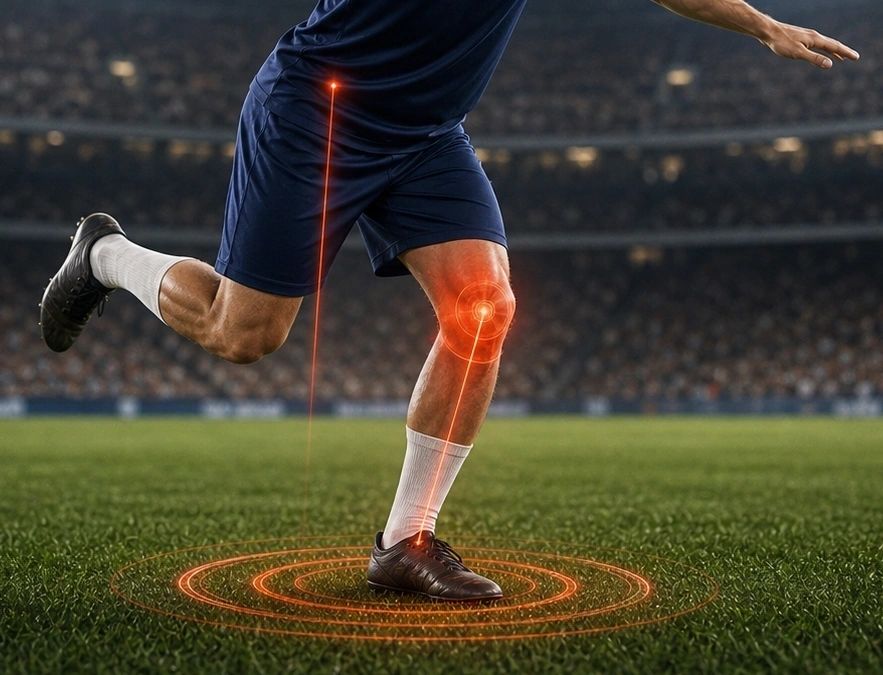
An anterior cruciate ligament (ACL) injury can interrupt sport for months and require extensive rehabilitation. No exercise program can prevent every ACL tear—especially those caused by direct contact—but well-designed training can reduce the risk of non-contact injuries.
Many non-contact ACL injuries happen during sudden changes of direction, awkward landings or rapid stopping. Prevention training aims to improve how the whole body handles these moments. It is particularly relevant to sports such as football, netball, basketball, rugby, skiing and gymnastics.
Why an ordinary warm-up may not be enough
A few laps followed by static stretching may raise body temperature, but this alone does not teach safer landing, turning and stopping. An effective ACL warm-up combines running with balance, leg and trunk strength, jumping, landing and change-of-direction exercises.
Technique matters. When landing, athletes should practise keeping the hip, knee and foot aligned, bending through the hip and knee, and absorbing force quietly rather than landing stiff-legged. During cutting, good control of the trunk and planted leg helps prevent the knee collapsing inward.
The program must also be performed regularly. A structured warm-up used only occasionally is unlikely to provide the same benefit as one completed consistently throughout training and competition. Coaches should teach technique, correct poor movement and gradually increase difficulty.
What is the FIFA 11+ program?
The FIFA 11+ is a structured injury-prevention warm-up originally designed for football players aged approximately 14 years and older. It takes about 20 minutes and has three sections: running exercises; strength, balance and jumping exercises at progressive levels; and faster running with changes of direction.
It includes exercises such as planks, side planks, squats, single-leg balance and jumping. These activities prepare the player for sport while improving strength and control. The program is designed to replace a usual warm-up, rather than become a separate lengthy training session.
In a large randomised trial of young female footballers, the structured warm-up reduced overall injuries by about one-third and severe injuries by nearly one-half when used consistently (BMJ randomised trial). A systematic review of randomised trials found that the FIFA 11+ reduced football injuries by approximately 30% overall (systematic review). A more recent comparison of football prevention programs ranked FIFA 11+ as the most effective option studied for reducing ACL injury risk, although estimates remain uncertain because ACL tears are relatively uncommon (2024 network meta-analysis).
These results describe groups, not a guarantee for an individual. Benefits also depend on correct technique and participation. Teams gain little from an excellent program that is rarely completed.
Proprioception: knowing where your knee is
Proprioception is the body’s ability to sense joint position and movement without looking. It helps an athlete recognise where the knee, hip and ankle are during a landing or change of direction. Coordination is the ability to organise those movements smoothly and at the right time.
Both skills can be trained. Examples include standing on one leg while reaching or catching a ball, controlled single-leg squats, landing and holding position, hopping in different directions, and reacting to a partner’s movement. Unstable surfaces can sometimes add difficulty, but advanced equipment is not essential.
The goal is not simply to remain balanced. The athlete must learn to control the trunk, hip, knee and ankle together, first in predictable exercises and later during faster, more sport-specific tasks. Fatigue should also be introduced gradually because technique often deteriorates late in training or competition.
Neuromuscular programs combine proprioception and coordination with strength, jumping and agility work. Evidence supports this combined approach, particularly for young female athletes, rather than relying on balance exercises alone. The most effective programs generally include multiple components and sufficient training exposure (meta-regression of ACL prevention programs).
Strength, workload and recovery
Strong quadriceps, hamstrings, calf, hip and trunk muscles help absorb force and control the knee. Useful exercises may include squats, lunges, step-downs, calf raises, hamstring exercises and progressive jumping. Quality is more important than adding weight quickly.
Training load should increase gradually. Sudden spikes in matches, training intensity or tournament volume may leave an athlete fatigued and less able to control movement. Appropriate footwear, a suitable playing surface, recovery, sleep and management of previous injuries also form part of a sensible prevention plan. Braces have specific uses, but a brace alone does not replace neuromuscular training.
Preventing another ACL injury after reconstruction
After ACL reconstruction, prevention must address both the reconstructed knee and the opposite knee. A systematic review found that young athletes returning to sport had an overall second ACL injury rate of approximately 23%: about 11% ruptured the graft and 14% injured the opposite ACL, with a small number sustaining both (systematic review and meta-analysis). Risk varies considerably with age, sport, activity level and follow-up.
Time alone does not determine readiness. In the Delaware–Oslo cohort, the reinjury rate fell by 51% for each month that return to high-risk sport was delayed up to nine months after surgery. Athletes who passed strength and hop-test criteria also had a lower reinjury rate (British Journal of Sports Medicine cohort study). This was an observational study, so the percentage should guide discussion rather than serve as a guarantee or universal deadline.
Before returning to pivoting sport, rehabilitation should assess swelling, range of movement, leg strength, hopping, landing and cutting technique, fitness and psychological readiness. Prevention exercises should continue after return; completing rehabilitation is not the end of injury-risk management.
Making prevention part of sport
The most practical program is one that a team or athlete will perform consistently. Two or more structured sessions each week, incorporated into the normal warm-up and supervised initially by someone who understands the exercises, is a reasonable approach. Younger athletes benefit from learning good movement patterns before poor habits become established.
Anyone with knee pain, swelling, instability or a recent injury should obtain an individual assessment before starting high-level jumping or change-of-direction drills.
ACL prevention is not one stretch, exercise or piece of equipment. It is a consistent approach combining an active warm-up, strength, proprioception, coordination, good technique and sensible recovery. Programs such as FIFA 11+ make these principles easier to apply—and regular participation is what gives them value.
This article provides general information only and should not be considered individual medical advice. Treatment decisions should be made following a thorough assessment and discussion with your treating orthopaedic surgeon. It is not possible to determine the most appropriate procedure without considering your individual symptoms, examination findings and imaging.


