neck of femur fracture
Neck of Femur Fracture Surgery – Brisbane
This page provides general information for patients of Dr Borshch and their families who are being treated for a neck of femur fracture (hip fracture) in Brisbane and may require orthopaedic surgery. Treatment depends on the type of fracture, age, general health and mobility before the injury. Options include fixing the fracture with screws or other implants, partial hip replacement (hemiarthroplasty) or total hip replacement.
A hip fracture usually requires urgent assessment and treatment, so your individual management should always follow advice from your orthopaedic surgeon and hospital treating team.

What is a Neck of Femur Fracture?
The neck of the femur is the short section of bone connecting the ball of the hip joint (femoral head) to the main part of the thigh bone.
A neck of femur fracture, commonly called a hip fracture, is a break through this area.
These fractures are particularly common in older people, where osteoporosis can weaken the bone enough that a relatively simple fall causes a fracture. In younger patients, neck of femur fractures are less common and usually result from higher-energy injuries.
One important feature of these fractures is their relationship to the blood supply of the femoral head. Some blood vessels supplying the ball of the hip travel along the femoral neck and can be damaged when the fracture moves out of position.
This influences whether the best treatment is to repair the patient's natural hip or replace the damaged part of the joint.
Why is Surgery Performed for a Neck of Femur Fracture?
Most neck of femur fractures require surgery.
The aims of hip fracture surgery are to:
- stabilise or replace the broken part of the hip
- reduce pain
- allow the patient to sit, stand and walk as early as possible
- reduce complications associated with prolonged bed rest
- help restore mobility and independence
The best operation depends particularly on whether the fracture is displaced or undisplaced, as well as the patient's age, bone quality, general health and activity level.
Undisplaced neck of femur fractures
When the fracture remains well aligned, it may be possible to preserve the patient's natural hip.
The fracture can be stabilised using screws or another fixation device while the bone heals.
Displaced neck of femur fractures
When the fracture has significantly moved out of position, particularly in older patients, the blood supply to the femoral head may have been damaged.
Fixation can then carry a higher risk of non-union, where the fracture does not heal, or avascular necrosis, where the femoral head loses its blood supply.
For this reason, hip replacement is commonly used for displaced fractures in older patients.
What Types of Neck of Femur Fracture Surgery Are Available?
There are three main surgical approaches.
1. Internal fixation – preserving the natural hip
Internal fixation aims to hold the broken bone securely while it heals.
Depending on the fracture, this may involve:
- multiple screws
- a larger screw and side plate
- another specialised fixation device
The advantage is that the patient's natural hip joint is preserved.
This approach is particularly important in younger patients, where every reasonable attempt is generally made to preserve the natural femoral head.
Fixation may also be appropriate for selected undisplaced fractures in older patients.
The disadvantage is that the fracture still needs to heal. If healing fails or the femoral head loses its blood supply, further surgery including hip replacement may eventually be required.
2. Hemiarthroplasty – partial hip replacement
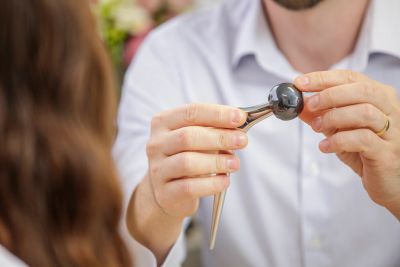
A hemiarthroplasty replaces the broken femoral head and neck while preserving the patient's natural hip socket.
The damaged femoral head is removed and a metal stem is inserted into the thigh bone. A new artificial ball then moves within the patient's existing hip socket.
This is commonly used for displaced neck of femur fractures in older patients.
Because the fracture itself no longer needs to heal for the hip to function, hemiarthroplasty usually provides a stable reconstruction that allows early weight-bearing.
3. Total hip replacement
A total hip replacement (total hip arthroplasty) replaces both sides of the hip joint.
The fractured femoral head is removed and replaced with a metal stem and new ball, while the natural hip socket is replaced with an artificial socket.
Total hip replacement may be considered for selected patients who were:
- independently mobile before their fracture
- physically active
- medically fit enough for the larger operation
- expected to remain active and independent
A major randomised controlled trial published in the New England Journal of Medicine compared total hip replacement with hemiarthroplasty in independently mobile patients with displaced femoral neck fractures. Both treatments produced similar rates of secondary procedures, while total hip replacement provided a modest functional advantage but also had a higher risk of hip instability or dislocation.
This means that total hip replacement is not automatically better than hemiarthroplasty. The operation needs to be selected for the individual patient.

How is Neck of Femur Fracture Surgery Performed?
Hip fracture surgery is generally performed as soon as it is medically safe.
1. Anaesthetic
A spinal or general anaesthetic may be used.
Because neck of femur fractures commonly occur in older patients, the anaesthetic and medical teams also assess other health problems that may affect surgery.
2. Internal fixation
If the hip is being preserved, the fracture position is checked using X-rays during the operation.
If necessary, the fracture is carefully repositioned before screws or other implants are inserted across the fracture to hold it securely.
3. Hip replacement
For hemiarthroplasty or total hip replacement, the fractured femoral head is removed.
The femur is prepared to accept a metal stem. In many older patients this is fixed using bone cement, which provides immediate fixation even when the underlying bone is relatively weak.
For hemiarthroplasty, a new artificial ball moves against the patient's natural socket.
For total hip replacement, the socket is also replaced with a metal shell and plastic or ceramic liner.
4. Closing the hip
The deeper tissues are carefully repaired and the incision is closed in layers before a dressing is applied.
Preparing for Neck of Femur Fracture Surgery in Brisbane
Unlike elective orthopaedic surgery, a hip fracture happens unexpectedly. There is usually little opportunity for traditional pre-operative preparation.
The priority is to make the patient medically ready for surgery without unnecessary delay.
Medical preparation
This may include:
- blood tests
- an ECG
- review of blood-thinning medications
- treatment of dehydration
- pain management
- assessment of heart and lung conditions
- anaesthetic and medical review
There is good evidence supporting timely surgery. A large systematic review and meta-analysis involving more than 190,000 hip fracture patients found that earlier surgery was associated with lower mortality and fewer pressure sores.
Sometimes a short delay is necessary to treat an important medical problem and make surgery safer.
Preparing the home for recovery
Because the injury is unexpected, family members may need to help prepare the patient's home while they are in hospital.
Remove loose rugs and trip hazards and consider access to the bedroom, shower and toilet. Physiotherapists and occupational therapists can recommend walking aids and other equipment.
Because Brisbane has a warm and humid climate, particularly during summer, access to a cool, comfortable and preferably air-conditioned environment can make early recovery more comfortable. Published research has found an association between warmer weather and higher rates of surgical-site infection, so keeping the patient comfortable and the surgical dressing clean and dry is particularly important during Brisbane's warmer months.
What to Expect After Neck of Femur Fracture Surgery
In hospital
The aim is usually to get patients sitting, standing and walking as early as safely possible.
You can expect:
- several different approaches to pain relief
- early physiotherapy and walking assistance
- blood clot prevention
- management of other medical conditions
- nutritional assessment
- falls and bone-health assessment
- planning for discharge and rehabilitation
Patients having a hip replacement can commonly put weight through the operated leg relatively early.
Weight-bearing after internal fixation depends on the fracture, fixation and individual patient.
First 2–6 weeks
Recovery varies considerably according to age, health, type of fracture and mobility before the injury.
Some patients return directly home, while others benefit from inpatient or community rehabilitation.
Walking aids are commonly required during early recovery.
6 weeks to 3 months
Walking, strength and confidence should progressively improve.
Patients treated with internal fixation will also have X-rays to assess fracture healing.
3 to 12 months
Recovery from a hip fracture involves much more than healing the surgical incision.
The aim is to regain as much mobility, independence and confidence as possible. Some patients return close to their previous level of function, while others require ongoing assistance.
Long-Term Outcomes After Neck of Femur Fracture Surgery
Walking and function
Hip fracture surgery provides the mechanical stability needed to begin rehabilitation, but overall recovery depends heavily on the patient's health and function before the fracture.
A neck of femur fracture is therefore not simply a broken bone—it can be a significant medical event, particularly in older people.
Preserving the hip versus replacing it
In younger patients, preserving the natural femoral head is generally particularly important.
In older patients with displaced fractures, arthroplasty avoids some of the problems associated with waiting for a fracture with a potentially damaged blood supply to heal.
A Cochrane systematic review comparing arthroplasty with internal fixation for intracapsular hip fractures found that internal fixation involved less initial surgical trauma but was associated with substantially more subsequent surgery.
The balance therefore changes depending on the patient and fracture.
Hemiarthroplasty versus total hip replacement
For appropriately selected patients, both operations are established treatments.
Total hip replacement may offer some functional advantages for healthier and more active patients, while hemiarthroplasty is a somewhat smaller operation and has a lower risk of dislocation in some studies.
The decision should therefore be based on pre-fracture mobility, general health, cognition, existing arthritis and likely future activity, rather than age alone.
Preventing another fracture
A neck of femur fracture following a relatively minor fall may indicate osteoporosis or reduced bone strength.
After surgery, it is important to consider:
- osteoporosis assessment and treatment
- vitamin D and calcium when appropriate
- strength and balance exercises
- reviewing medications that may contribute to falls
- vision assessment
- home safety and falls prevention
Treating the fracture is important, but preventing the next fall and next fracture is also an important part of long-term care.
Things to Look Out for After Hip Fracture Surgery
Contact the treating team, your GP, or seek urgent medical attention if you notice:
Possible infection
- increasing redness or warmth around the incision
- persistent wound leakage
- pus or unusual discharge
- increasing pain after initially improving
- fever or feeling significantly unwell
Possible blood clot
Seek medical attention for:
- new calf pain or tenderness
- significant one-sided leg swelling
- sudden shortness of breath or chest pain
Sudden breathing symptoms require emergency assessment.
Hip dislocation after replacement
Sudden severe hip pain, inability to move the leg or a leg that appears shortened or abnormally rotated requires urgent assessment.
Problems after internal fixation
Increasing hip or groin pain, worsening ability to walk or failure to progressively improve can sometimes indicate problems with fracture healing or fixation and should be assessed.
Another fall
Any significant new hip pain or inability to walk following another fall should be assessed.
Confusion or sudden deterioration
Older patients can develop delirium (acute confusion) during or after treatment for a hip fracture.
New or worsening confusion, unusual sleepiness, agitation or sudden deterioration in general health should be brought to the attention of the treating team.
Neck of femur fracture surgery

Dr Alexey Borshch is a specialist orthopaedic surgeon in Brisbane with a particular clinical focus on surgery of the hip, knee and lower limb.
His practice as a Brisbane orthopedic surgeon focuses on the assessment and treatment of hip conditions as well as performing hip fracture surgery.
Dr. Borshch completed his medical degree at the University of Queensland and later underwent specialist orthopaedic training in Queensland, achieving Fellowship status with the Royal Australasian College of Surgeons in Orthopaedic Surgery.
He offers consultations in Hamilton, Brisbane, and conducts private orthopaedic surgery at Brisbane Private Hospital.