
What is microfracture?
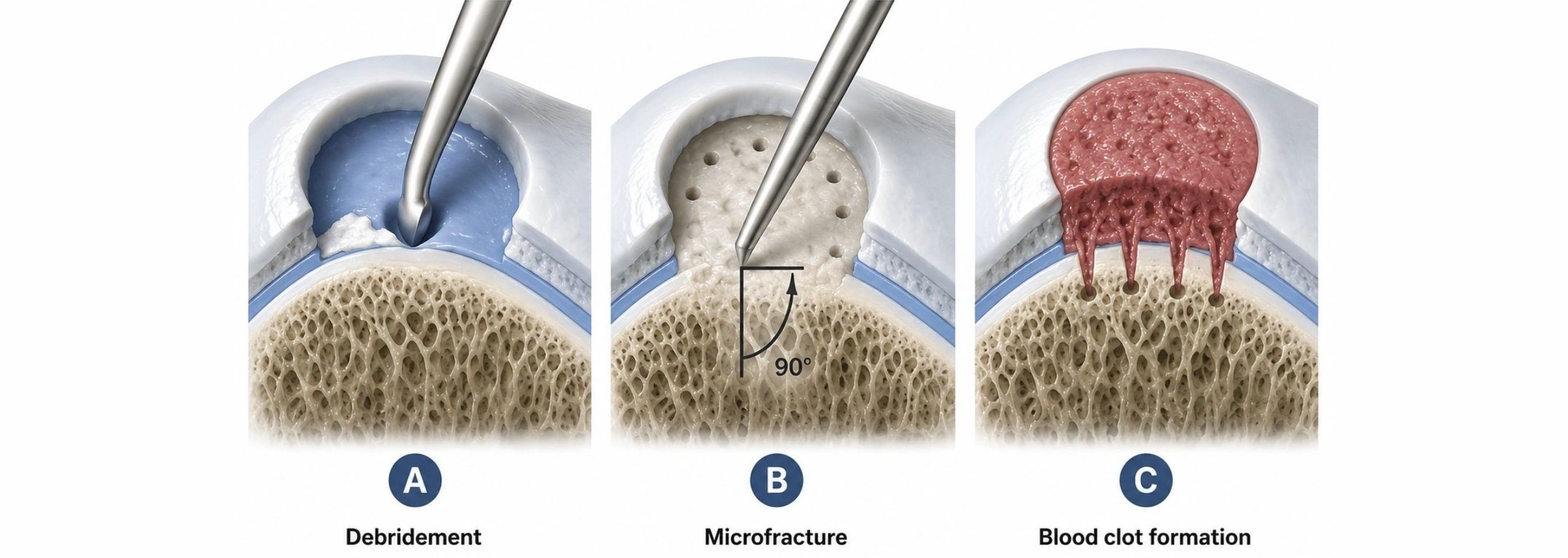
Microfracture is a keyhole (arthroscopic) operation to treat a small area of damaged joint cartilage in the knee. Joint (articular) cartilage is the smooth lining on the ends of the bones. It has a limited ability to heal, so a full-thickness hole in it, called a cartilage defect, can cause pain, swelling and catching.
The surgeon first removes the loose and damaged cartilage so that the defect has stable edges. A small, pointed instrument (an awl) is then used to make several tiny holes, about 3–4 mm apart, through the hard layer of bone under the cartilage (the subchondral bone). Blood and bone marrow cells seep out of these holes and form a clot in the defect, which uses the body's own healing ability to grow new repair tissue (PMID 10081041). This repair tissue is mostly fibrocartilage, a tougher, scar-like type of cartilage that is not the same as the original smooth (hyaline) cartilage (PMID 19251676; PMID 25660008).
Microfracture is one of several cartilage repair options. It is mainly used for small defects, and has shown its best results in younger people (PMID 23992991; PMID 25660008). A thorough clinical examination by a specialist and modern imaging, usually an MRI scan, help confirm the diagnosis, and arthroscopy confirms the exact size and position of the defect at the time of surgery. Microfracture can be combined with other procedures, such as ACL reconstruction or meniscus surgery.
What are the benefits of microfracture?
Microfracture is a minimally invasive, single-stage operation that is done through small incisions and uses your own healing response, without the need to take tissue from elsewhere or grow cells in a laboratory (PMID 10081041). A review of 28 studies including more than 3,000 patients found that microfracture improved knee function in every study during the first 2 years after surgery (PMID 19251676).
Good results can last in well-chosen patients. In a study of 72 people aged 45 or younger with a cartilage defect caused by an injury, followed for an average of 11 years, knee scores and activity levels improved significantly, and 80% rated their knee as improved 7 years after surgery (PMID 12724676). In a review of studies with an average follow-up of 7 years, knee scores improved after microfracture to a similar degree as after a more complex cell-based cartilage operation (autologous chondrocyte implantation) (PMID 28423287).
What are the risks of microfracture?
The main limitation of microfracture is that the repair tissue is mostly fibrocartilage, which is less hard-wearing than normal joint cartilage. The amount of defect filled varies between people, and the early improvement may not last (PMID 19251676; PMID 25660008). A review of the highest-quality studies found that good short-term results were mainly seen in small defects and in people with lower physical demands, and that failures and arthritis appeared 5 to 10 years after surgery (PMID 23992991).
Microfracture may be less suitable for very active people. In a randomised trial of young athletes, 38% of the microfracture repairs had failed by 10 years, compared with 14% after an osteochondral autograft transfer (PMID 23024150), and a review of 52 studies found that athletes were more likely to return to a lower level of sport after microfracture than after other cartilage procedures (PMID 39790040). Newer techniques have shown better short-term results and lower failure rates than microfracture in some trials (PMID 35283221; PMID 37148615).
If microfracture does not work, a different cartilage operation may be needed later. Some studies have found poorer results when a cell-based cartilage repair is done after a failed microfracture (PMID 31407047), although others have found similar results (PMID 32053398).
Other possible problems include swelling, stiffness, ongoing pain, blood clots in the leg and infection. Recovery involves a period of rehabilitation while the repair tissue matures. There are also risks from the anaesthetic, which your anaesthetist will discuss with you.
Summary
Microfracture is a keyhole operation that makes small holes in the bone under a cartilage defect so that the body can fill it with repair tissue. It is usually recommended when the expected benefits for you outweigh the risks. You should discuss your symptoms, your scans and your goals, including plans for sport and work, with your knee surgeon so that you can consider the options, such as an osteochondral autograft transfer, and the indications for surgery together.
General information only. The information on this page is general in nature and does not replace individual medical advice. All surgery carries risks, and results vary between patients. Please discuss your own circumstances with your treating practitioner.