
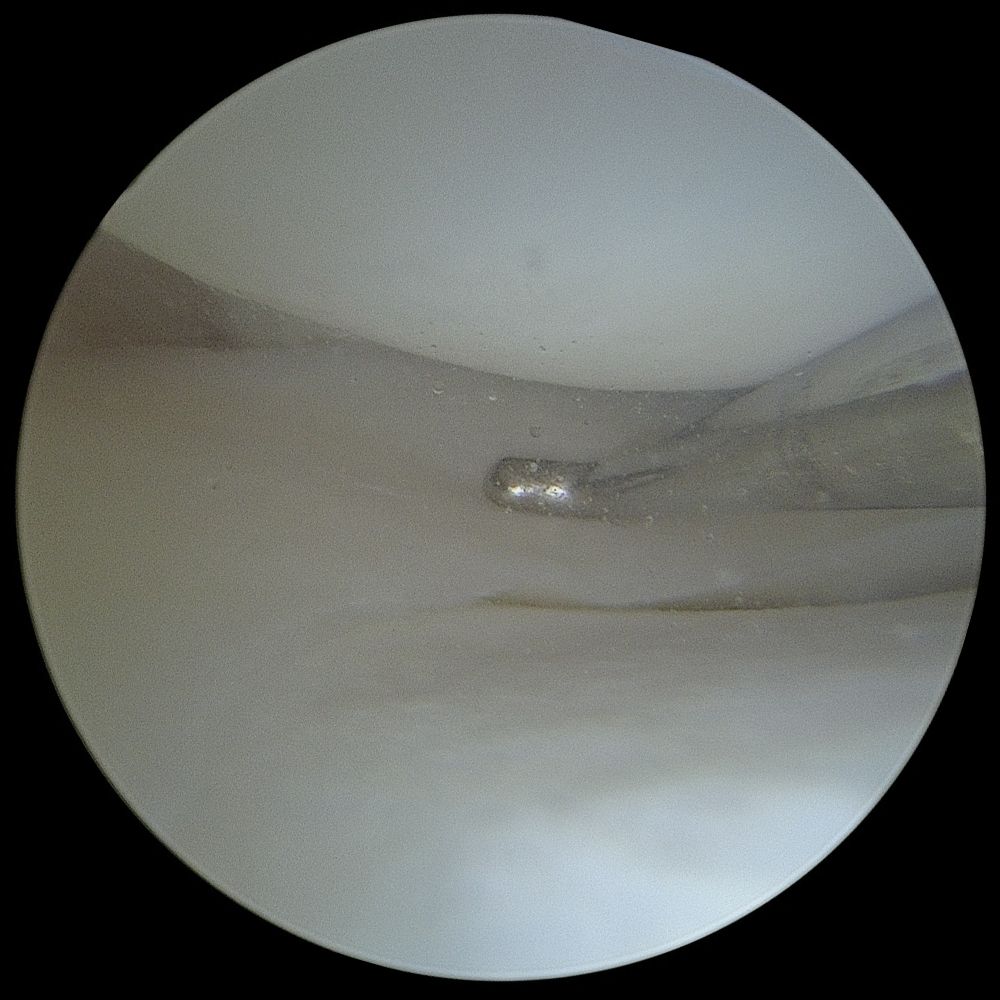
What is a minced cartilage autograft?
A minced cartilage autograft (also called minced cartilage implantation) is an operation to repair an area of damaged joint cartilage in the knee. Joint (articular) cartilage is the smooth lining on the ends of the bones. It has a limited ability to heal, so a full-thickness hole in it, called a cartilage defect, can cause pain, swelling and catching. "Autograft" means that the tissue used for the repair comes from your own body.
The surgeon collects healthy cartilage, usually from the edges of the defect or from a less weight-bearing part of the knee, and cuts it into very small fragments, either by hand with a scalpel or with a keyhole shaver. In the same operation, the fragments are placed into the prepared defect and usually sealed in place with fibrin glue (a biological glue). The living cartilage cells in the fragments can then grow out and form new repair tissue (PMID 32715735; PMID 40053917). Some surgeons use a proprietary collection system, such as AutoCart (Arthrex), which collects and minces the cartilage through a keyhole shaver (PMID 39640183). An earlier system, the Cartilage Autograft Implantation System (CAIS), was tested in a clinical trial (PMID 21460066).
A minced cartilage autograft is one of several cartilage repair options, and it can be used for both small and larger defects, including defects that involve the bone under the cartilage (PMID 32715735). A thorough clinical examination by a specialist and modern imaging, usually an MRI scan, help confirm the diagnosis, and arthroscopy confirms the exact size and position of the defect at the time of surgery. The procedure can be done arthroscopically or through a small open incision, and it can be combined with other procedures, such as ACL reconstruction or meniscus surgery (PMID 39640183).
What are the benefits of a minced cartilage autograft?
A minced cartilage autograft is a single-stage operation that uses your own living cartilage cells, without the need to grow cells in a laboratory or have a second operation (PMID 32715735; PMID 36422099). A review of the best available studies found that knee function and pain scores improved significantly at 1 and 2 years after surgery, to a similar degree as after standard cartilage repair techniques (PMID 36422099).
Good results can last. In a study of 28 people followed for more than 5 years, the typical pain score fell from 7 to 2 out of 10, and three in four people reached a level of knee function that patients usually consider acceptable (PMID 37634136). In a randomised trial, people treated with a minced cartilage technique had better knee scores at 2 years than people treated with microfracture (PMID 21460066). In a matched comparison, results were similar to those after a two-stage, cell-based cartilage operation (autologous chondrocyte implantation) (PMID 41353730), and a 2026 review of 41 studies found outcomes that were at least comparable to both of these procedures (PMID 42743060).
What are the risks of a minced cartilage autograft?
A minced cartilage autograft is a newer technique. Most studies so far are small and have followed patients for only a few years, long-term results are not yet known, and there is not yet one standard way of doing the procedure (PMID 40053917; PMID 42743060).
The repair tissue is not always the same as normal joint cartilage, and the repair does not always take. In a study of 11 knees, MRI scans at 2 years showed that the repair tissue was on average different from normal cartilage, and in 3 knees no transplanted cartilage could be seen (PMID 41071351). Not everyone improves as much as hoped: in one matched comparison, people did better after a different technique, which combines microfracture with a collagen membrane (autologous matrix-induced chondrogenesis), than after hand-minced cartilage (PMID 39077845).
Further surgery is sometimes needed. In a study of 62 people, 8% had another operation within 2 years, mainly because the repair tissue had grown too thick (hypertrophy) (PMID 39640183). In the study of 28 people followed for 5 years, 4 had a problem related to the graft, and 1 of them needed revision surgery (PMID 37634136).
Other possible problems include swelling, stiffness, ongoing pain, blood clots in the leg and infection. Recovery involves a period of rehabilitation while the repair tissue matures. There are also risks from the anaesthetic, which your anaesthetist will discuss with you.
Summary
A minced cartilage autograft repairs a cartilage defect with small fragments of your own cartilage in a single operation. It is usually recommended when the expected benefits for you outweigh the risks. You should discuss your symptoms, your scans and your goals, including plans for sport and work, with your knee surgeon so that you can consider the options, such as an osteochondral autograft transfer, and the indications for surgery together.
General information only. The information on this page is general in nature and does not replace individual medical advice. All surgery carries risks, and results vary between patients. Please discuss your own circumstances with your treating practitioner.