
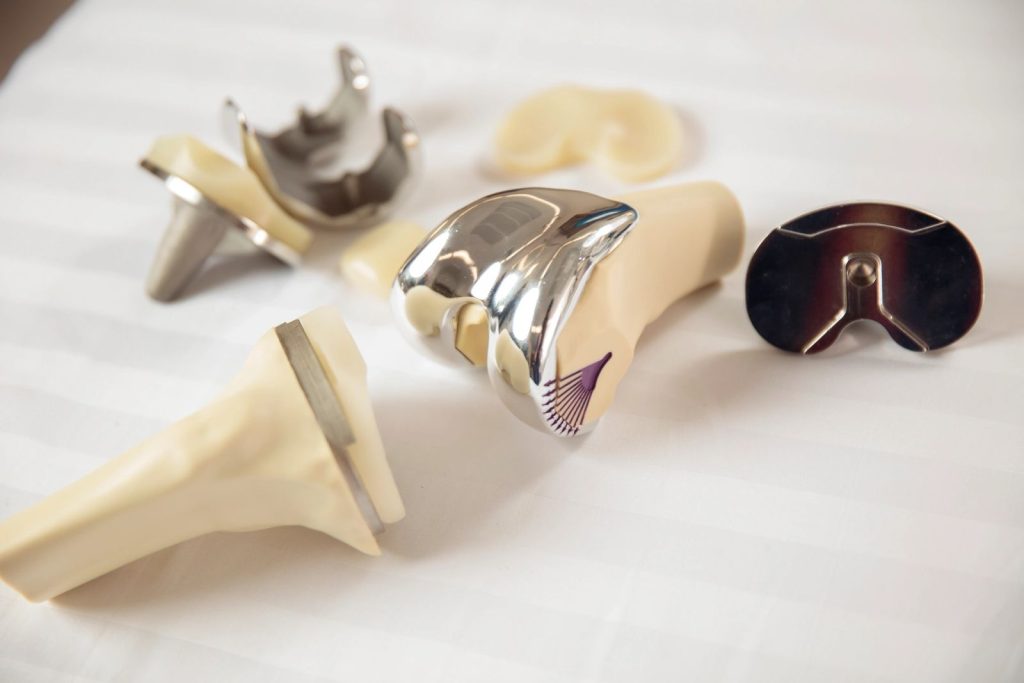
Your recovery starts on the day of surgery and continues for many months.
This page provides general information for patients ofDr Borshchhavingtotal knee replacementsurgery in Brisbane. Recovery varies between patients, so your rehabilitation should follow the individual advice provided by your surgeon and physiotherapist.
A knee replacement is not an operation where you simply wait for the knee to heal. Walking, movement, swelling control and progressive strengthening are all important parts of recovery.
It is also normal to have good days and bad days. Recovery is rarely a perfectly straight line.
Day 0: Getting Up on Your New Knee

In most cases, walking begins on the same day as your knee replacement.
Once your anaesthetic has worn off sufficiently and it is safe to stand, a physiotherapist will help you get out of bed.
Initially you will usually use a walking frame or crutches. The goal is not to walk a long distance—it is simply to stand safely, put weight through the new knee and begin moving.
Same-day mobilisation is now an established part of modern knee replacement recovery. A randomised trial of physiotherapy beginning on the day of total knee replacement demonstrated that mobilisation on postoperative day 0 can be performed safely and can assist earlier hospital discharge.
Your first exercises usually focus on ankle movement, activating the thigh muscles, straightening the knee and beginning gentle bending.
The first several days are usually the most uncomfortable part of recovery.
A knee replacement is major surgery, so some pain is expected.
Pain can fluctuate considerably. The knee may feel surprisingly comfortable initially because of the anaesthetic, local anaesthetic and nerve blocks, before becoming more uncomfortable as these wear off.
Modern pain management therefore uses several different types of pain relief together, rather than relying on one medication. A large systematic review of pain management following knee replacement supports this multimodal approach.
The aim is not necessarily to make the knee completely pain-free. It is to keep pain controlled enough that you can sleep, walk and participate in rehabilitation.
Pain should gradually trend downwards. A sudden substantial increase after the knee had been improving deserves attention.
Weeks 1–2: Swelling, Ice and Finding a Routine
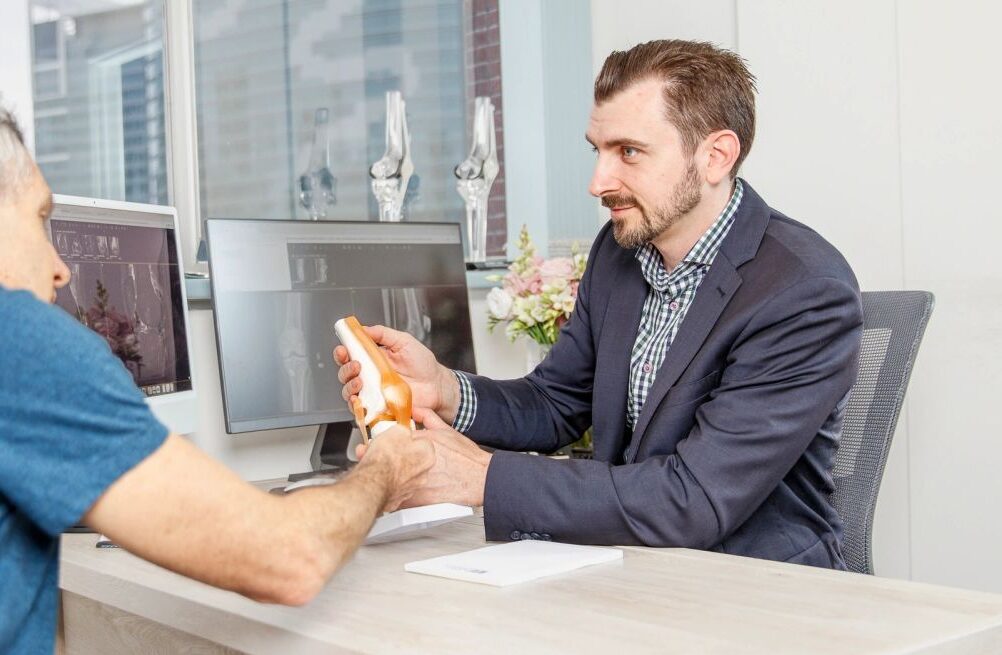
Swelling, bruising and stiffness are expected during early knee replacement recovery.
The knee and leg can become quite swollen. Bruising may travel down the shin towards the ankle and foot, and swelling is often worse later in the day.
Elevation, regular movement and ice or cryotherapy can help.
A recent systematic review and meta-analysis of cryotherapy after total knee replacement found reductions in early postoperative pain and opioid requirements and some improvement in range of movement. Importantly, sophisticated cold-flow machines were not clearly superior to conventional cold packs.
Compression may also help some patients with swelling and comfort, although evidence for particular devices is less consistent.
Think of ice and compression as tools to make movement and rehabilitation easier, rather than treatments that replace exercise.
Weeks 2–6: Physiotherapy and Regaining Movement

The main goals are a straighter knee, increasing bend and a more normal walking pattern.
Physiotherapy becomes an important part of establishing good movement and strength.
Typical goals include:
- achieving full or near-full knee extension
- progressively improving knee flexion
- strengthening the quadriceps
- improving walking
- reducing reliance on crutches or a walking stick
- safely managing stairs and everyday activities
There is no single rehabilitation program that has been proven to be ideal for everybody. A major systematic review of 53 rehabilitation trials after total knee replacement found that several different rehabilitation approaches can produce comparable improvements.
Similarly, research comparing supervised outpatient physiotherapy with home exercise programs found broadly similar short-term improvements in movement and physical function in appropriately selected patients.
The important ingredients are regular movement, appropriate exercises, progressive strengthening and monitoring of your progress.
Your Knee Bend: Do Not Compare Yourself With Everyone Else
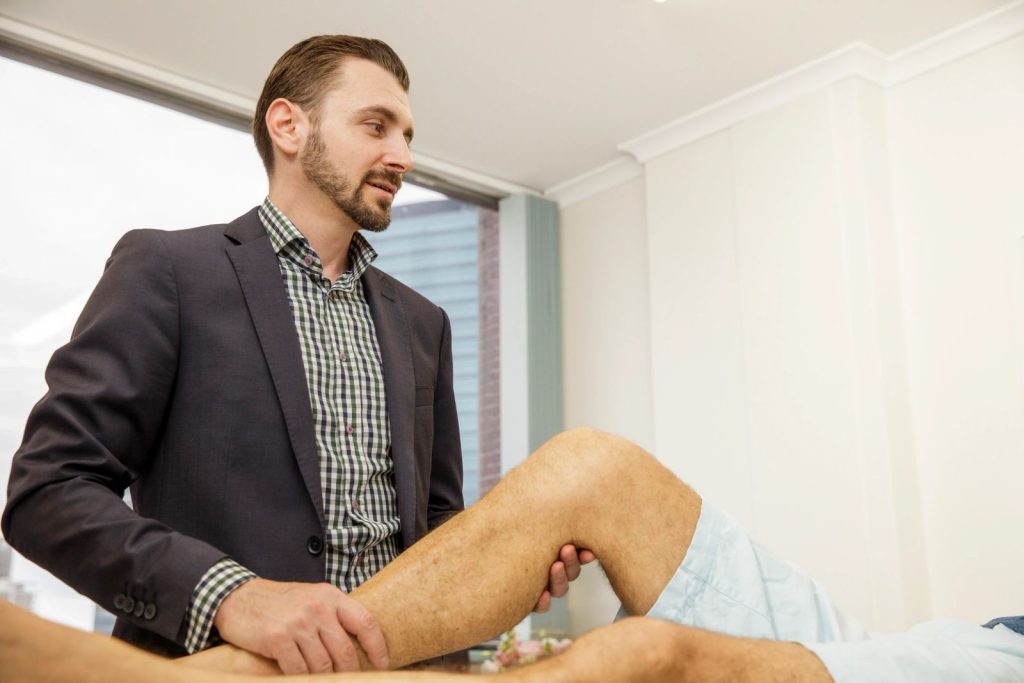
Knee movement improves over time, and each person recovers at a different pace.
Patients frequently worry about whether they have achieved the “correct” number of degrees.
I generally aim for at least 90 degrees of flexion by around six weeks, but this is a guide rather than a pass-or-fail test.
Your movement before surgery, swelling, pain and individual anatomy all influence recovery.
A study following 559 knee replacement patients for one year found that range of movement changed most rapidly during the first 12 weeks, with smaller improvements continuing afterwards. Read the study of knee range-of-motion recovery after TKR.
Regaining extension—getting the knee straight—is just as important as bending it because this affects standing and walking.
Weeks 6–12: Strength Becomes the Priority

As pain and swelling settle, rehabilitation increasingly shifts from healing to rebuilding strength.
The quadriceps becomes substantially weaker following knee replacement.
This weakness is an important reason why stairs, getting out of chairs and longer walks can remain difficult even when the arthritic pain has improved.
Research following patients after knee replacement found that quadriceps strength was strongly associated with functional recovery. Read the study of strength and functional recovery after TKR.
A recent systematic review and meta-analysis of resistance exercise after knee replacement found benefits for strength, mobility, function and knee flexion.
This phase increasingly focuses on strength, balance, endurance and returning to normal life, rather than simply trying to bend the knee further.
What Is Normal After Knee Replacement?
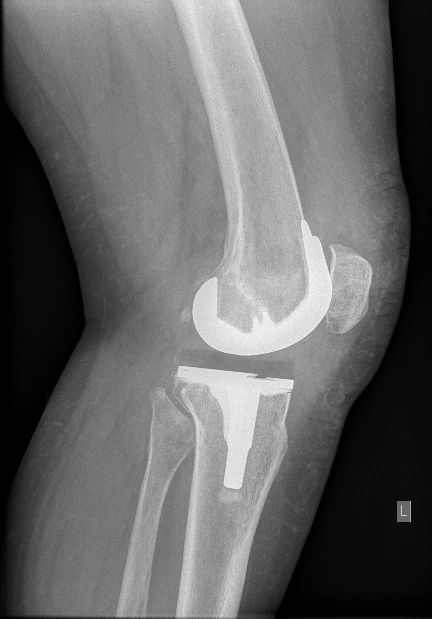
Warmth, swelling, numbness, poor sleep and occasional setbacks may be normal post TKR.
Several things commonly worry patients during recovery.
Warmth: The operated knee can remain noticeably warmer than the other knee for months. A prospective study of uncomplicated knee replacements found increased temperature remained measurable for at least six months. Warmth alone, without worsening redness, pain, wound problems or fever, is not necessarily infection.
Numbness: An area of altered sensation beside the incision is common because small skin nerves are divided during surgery.
Swelling: This often increases after exercise or towards the end of the day and can persist for months.
Poor sleep: Sleep disturbance is extremely common during early recovery. A systematic review of sleep following knee replacement found sleep commonly deteriorates early before improving as recovery progresses.
Clicks and mechanical sensations: A knee replacement contains metal and plastic components. Some patients can feel or hear these moving during certain activities.
Most importantly, one difficult day does not mean your recovery is going backwards. Activity often increases faster than the knee's ability to tolerate it, producing temporary increases in swelling and discomfort.
Three Months to One Year: Returning to Normal Life

Most early recovery occurs in the first few months, but improvement continues much longer.
By approximately three months, many patients are substantially more independent and are returning to normal everyday activities.
Strength, endurance, balance and confidence can continue improving for 6–12 months or longer.
Driving is individual. A systematic review of driving after knee and hip replacement found return after knee replacement was commonly around four weeks but varied substantially. I generally recommend a more cautious approach: you should be off sedating pain medication and able to confidently and rapidly control the vehicle, including performing an emergency stop.
Do not judge the final result of your knee replacement by how it feels at two or six weeks. At that stage you are still recovering from the operation.
When Should I Seek Help?

Some symptoms are part of normal recovery; others should be assessed promptly.
Contact our office, your GP or the hospital if you develop:
- increasing redness around the incision
- persistent wound leakage or pus
- fever or feeling significantly unwell
- pain that is becoming substantially worse rather than gradually improving
- progressive loss of knee movement
- new significant calf pain or swelling
- a sudden deterioration after a fall or injury
Seek urgent medical attention for sudden shortness of breath, chest pain or coughing blood, as these can be symptoms of a pulmonary embolism.
A rapidly increasing painful swelling, a cold or pale foot, or new significant weakness also requires urgent assessment.
My Approach to Rehabilitation After Knee Replacement

The goal is steady progress—not racing another patient's recovery.
For my patients having total knee replacement surgery, rehabilitation starts with standing and walking on the day of surgery and gradually progresses from movement and swelling control to strength, endurance and normal activity.
I encourage early mobilisation, regular physiotherapy and exercise, but I do not believe every patient needs to recover according to an identical timetable.
Published recovery data show considerable variation between patients. For example, large recovery-curve research involving almost 3,000 knee replacement patients found substantial improvements in movement, strength and walking during the first 8–10 weeks, but with considerable variation between individuals.
The important question is therefore not whether you are recovering at exactly the same speed as somebody else, but whether your pain, movement, strength and function are progressing appropriately over time.
For patients undergoing knee replacement with me inBrisbane, the rehabilitation plan is intended to help you safely progress from your first steps on the new knee to independent walking, improved strength and, ultimately, getting back to the activities for which you had the knee replacement in the first place.
Knee Replacement Rehabilitation in Brisbane

Dr Alexey Borshch is a specialist orthopaedic surgeon in Brisbane with a particular clinical focus on surgery of the hip, knee and lower limb.
His practice as a Brisbane orthopedic surgeon focuses on the assessment and treatment of knee arthritis, as well as performing knee replacement surgery and revision knee replacement surgery.
Dr. Borshch completed his medical degree at the University of Queensland before undertaking specialist orthopaedic training in Queensland. He completed the Australian Orthopaedic Association training program and the Royal Australasian College of Surgeons Fellowship Examination in Orthopaedic Surgery. He obtained specialist registration in Orthopaedic Surgery in 2022 and is a Fellow of the Australian Orthopaedic Association.
He offers consultations in Hamilton, Brisbane, and conducts private orthopaedic surgery at Brisbane Private Hospital.