
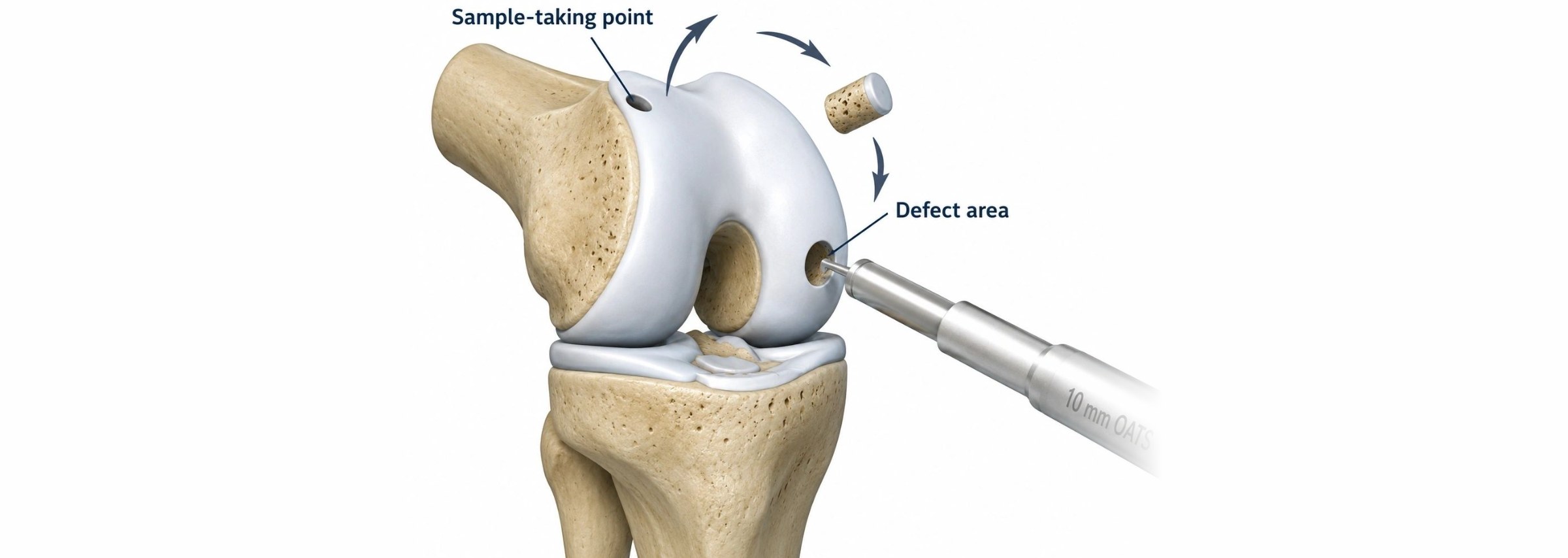
What is an osteochondral autograft transfer?
An osteochondral autograft transfer (OAT) is an operation to repair a small area of damaged joint cartilage in the knee. Joint (articular) cartilage is the smooth, glossy lining on the ends of the bones that lets the knee glide. It has a limited ability to heal, so a hole in it, called a cartilage defect, can cause pain, swelling and catching. "Osteochondral" means bone and cartilage, and "autograft" means tissue taken from your own body.
The surgeon takes one or more small cylinders (plugs) of bone with healthy cartilage on top from a less weight-bearing part of the same knee. The damaged area is prepared by making a matching hole, and the plug is pressed firmly into it so that the new cartilage surface sits level with the surrounding cartilage. When several smaller plugs are used side by side, the technique is called mosaicplasty (PMID 18313470; PMID 21240578). The operation can be done through keyhole (arthroscopic) incisions or a small open incision, depending on where the defect is.
OAT is one of several cartilage repair options. It is mainly used for small to medium-sized defects, often under about 2 cm² (about the size of a fingernail), in younger, active people (PMID 25617008; PMID 18313470). A thorough clinical examination by a specialist and modern imaging, usually an MRI scan, help confirm the diagnosis, and arthroscopy confirms the exact size and position of the defect at the time of surgery.
What are the benefits of an osteochondral autograft transfer?
The main benefit of an osteochondral autograft transfer is that the defect is filled with your own living bone and normal-type (hyaline) cartilage, the same kind of cartilage that lines a healthy joint. In a large series of more than 1,000 patients, good to excellent results were reported in 92% of people treated for defects on the thigh bone (femoral condyle), and follow-up arthroscopies showed that the transplanted cartilage survived (PMID 18313470). It is also a single-stage operation, unlike some other cartilage treatments that need two operations (PMID 41542709).
OAT has shown good results in active people. In a randomised trial of 60 young athletes, those treated with OAT had better results at 10 years than those treated with microfracture, and three in four kept playing sport at the same level as before (PMID 23024150). A review of studies comparing the two techniques also found better results and a higher rate of return to sport after OAT (PMID 25617008).

Return to sport is often relatively quick for a cartilage operation. A review of 52 studies found that OAT had the fastest average return to sport of the cartilage restoration procedures studied, at about 6 to 7 months, and people were likely to return at the same or a higher level (PMID 39790040). In a review of studies following people for an average of 15 years, 86% to 100% returned to sport and knee scores remained well above their levels before surgery (PMID 38056726).
What are the risks of an osteochondral autograft transfer?
An osteochondral autograft transfer does not suit every cartilage problem. There is only a limited amount of cartilage that can be taken from the less weight-bearing parts of the knee, so it is less suitable for large defects (PMID 25617008). In a review of 610 patients followed for about 10 years, the repair was considered to have failed in 28%, and 19% needed further surgery. Failure was more likely in older people, in larger defects and after previous knee surgery (PMID 26906461). In long-term studies, up to 16% of people later needed a knee replacement (PMID 38056726).
The evidence comparing OAT with other cartilage treatments is limited. A Cochrane review found only three small randomised trials comparing it with microfracture and judged the quality of evidence to be very low (PMID 27590275), and one of these trials found no difference between the two techniques at about 10 years (PMID 24441734).
Taking the plugs creates a new defect where the healthy cartilage was removed (the donor site). These holes fill with scar-type cartilage (fibrocartilage) and usually cause no trouble, but some people have ongoing pain, swelling or clicking from the donor site. Long-term donor-site problems were reported in 3% of patients in one large series (PMID 18313470), but they have been found more often when studies look for them carefully (PMID 21138224).
Other possible problems include bleeding into the knee in the early weeks (reported in nearly 8% in one large series), stiffness, ongoing pain, blood clots in the leg and infection, which is rare but serious (PMID 18313470). There are also risks from the anaesthetic, which your anaesthetist will discuss with you.
Summary
An osteochondral autograft transfer moves plugs of your own bone and healthy cartilage from a less weight-bearing part of the knee into a small cartilage defect, to restore a smooth joint surface. It is usually recommended when the expected benefits for you outweigh the risks. You should discuss your symptoms, your scans and your goals, including plans for sport and work, with your knee surgeon so that you can consider the options and the indications for surgery together.
General information only. The information on this page is general in nature and does not replace individual medical advice. All surgery carries risks, and results vary between patients. Please discuss your own circumstances with your treating practitioner.