
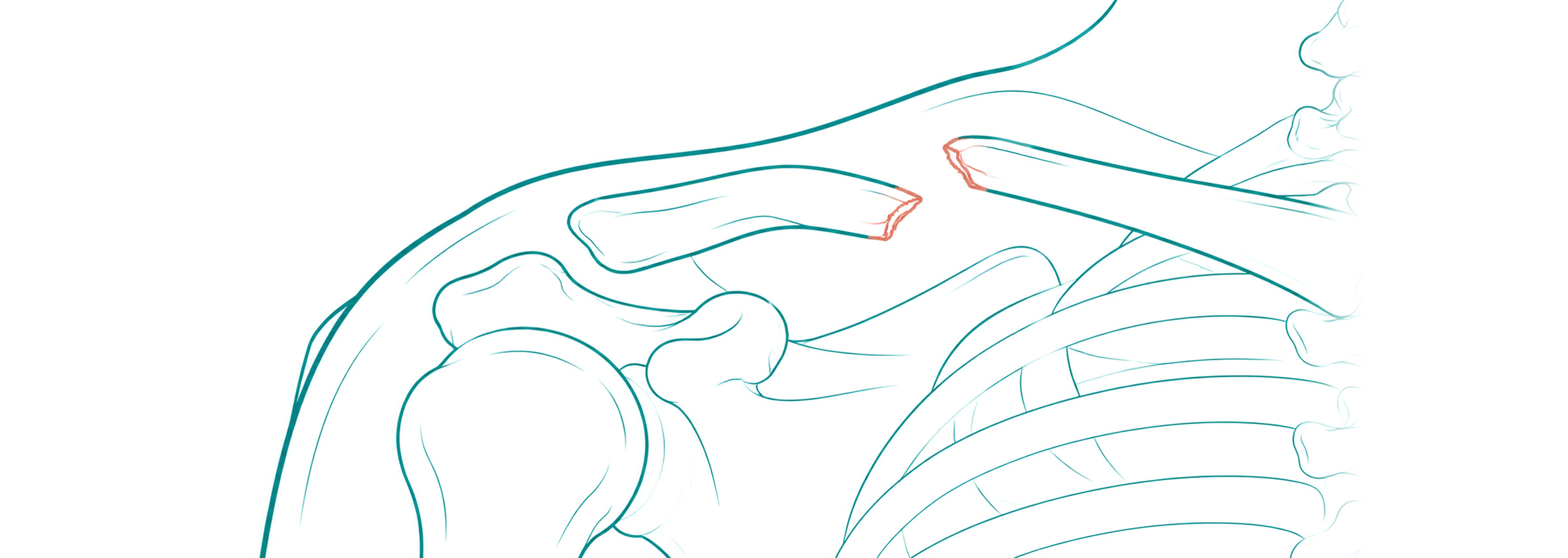
What is clavicle fracture surgery?
The clavicle (collarbone) is the long, S-shaped bone that runs across the front of the shoulder, connecting the breastbone to the shoulder blade. Clavicle fractures are common: in a study of 535 fractures they made up 2.6% of all fractures and 44% of fractures around the shoulder, and 81% were in the middle third (shaft) of the bone (PMID 12378163). In the Swedish Fracture Register of 2,422 fractures in people aged 15 and over, 68% occurred in males, the largest group was young men aged 15 to 24, and same-level falls and bicycle accidents were the most common causes (PMID 28202071).
Many clavicle fractures heal well without an operation, using a sling and gradual exercises. Surgery is mainly considered for fractures in which the bone ends have moved completely apart (displaced) or overlap and shorten the bone, because these have a higher risk of not healing (non-union) or healing in a poor position (malunion) (PMID 30666620; PMID 31851115). In a study of 868 people treated without surgery, the risk of non-union was higher with displaced fractures, fractures in several pieces (comminuted), increasing age and female sex; 11.5% of fractures at the outer end of the collarbone, near the shoulder, had not healed at 24 weeks (PMID 15252081).
The most common operation is open reduction and internal fixation: through an incision over the collarbone, the bone pieces are put back in position and held with a plate and screws. In Sweden, a plate was used in 94% of operated clavicle fractures (PMID 28202071). For suitable shaft fractures, an alternative is intramedullary fixation, in which a pin or nail is passed along the inside of the bone (PMID 30666620; PMID 28578086). Fractures at the outer end of the collarbone may be fixed with a specially shaped plate, including a hook plate (PMID 34128498).
A thorough clinical examination by a specialist and modern imaging help confirm the diagnosis. X-rays show where the fracture is, how far the bone ends have moved and whether the bone has broken into several pieces, which are important factors when weighing up treatment (PMID 15252081; PMID 31851115).
What are the benefits of clavicle fracture surgery?
Surgery restores the length and alignment of the collarbone and holds the bone steady while it heals. In a multicentre randomised trial of 132 adults with a displaced shaft fracture, plate fixation gave better shoulder function scores at every time point up to one year, faster healing (16.4 weeks on average compared with 28.4 weeks), fewer non-unions and no symptomatic malunions, and patients were more satisfied with the appearance of their shoulder (PMID 17200303).
Reviews of randomised trials support these findings. In a meta-analysis of nine trials, plate fixation lowered the risk of non-union, malunion and dissatisfaction with the appearance of the shoulder compared with non-surgical treatment (PMID 31096481). In a Cochrane review of 14 trials (1,469 participants), surgery reduced the need for a further operation to treat non-union, malunion or other complications, and symptomatic malunion occurred in 1.2% of people after surgery compared with 11.3% without surgery (PMID 30666620).
Surgery also helps fractures at the outer end of the collarbone heal. In a randomised trial of displaced outer-end fractures, 95% healed within one year after plate fixation compared with 64% without surgery (PMID 34128498). For suitable shaft fractures, intramedullary fixation took less operating time and had a lower infection rate than plate fixation, with similar shoulder function (PMID 28578086).
What are the risks of clavicle fracture surgery?
Surgery mainly reduces problems with bone healing; it may not improve long-term shoulder function. The Cochrane review found low-quality evidence that, at one year or more, surgery may not improve shoulder function, pain or quality of life compared with non-surgical treatment (PMID 30666620), and another meta-analysis found no difference in function scores (PMID 31851115).
Because the collarbone lies just under the skin, a plate can often be felt and may cause irritation. In a population study of 1,350 people in Ontario, Canada, 24.6% had at least one further operation within two years, most commonly to remove the implants (18.8%); further operations for non-union, deep infection and malunion were needed in 2.6%, 2.6% and 1.1% (PMID 24990977). Newer, thinner plates did not lower the removal rate (20.1% compared with 20.9%) (PMID 41010556). After plate fixation for outer-end fractures, 44% of people had a second operation to remove the implants, especially after hook plates (PMID 34128498).
In the Cochrane review, infection occurred in 3.2% of people after surgery, and 10.2% had their implants removed because of discomfort (PMID 30666620). Small skin nerves (the supraclavicular nerves) cross the collarbone, and numbness below the incision or on the upper chest is common after surgery; protecting these nerves during the operation reduced numbness in one study (PMID 37749619). Rare but serious complications include a collapsed lung (pneumothorax), which occurred in 1.2% of people in the Ontario study, and injury to the major blood vessels or nerves of the arm, which occurred in five or fewer of the 1,350 patients (PMID 24990977). Other possible problems include wound problems, a visible scar and the risks of the anaesthetic, which your anaesthetist will discuss with you.
Summary
Clavicle fracture surgery aims to restore the length and alignment of the collarbone, hold the bone steady while it heals and lower the risk of the bone not healing or healing in a poor position. Depending on the fracture, this may involve a plate and screws or a pin or nail inside the bone. Many clavicle fractures heal well without an operation, and surgery is usually recommended when the expected benefits for you outweigh the risks. You should discuss your injury, your X-rays and your goals, including your work, sport and other activities, with your fracture surgeon so that you can consider the options and the indications for treatment together.
General information only. The information on this page is general in nature and does not replace individual medical advice. All surgery carries risks, and results vary between patients. Please discuss your own circumstances with your treating practitioner.