
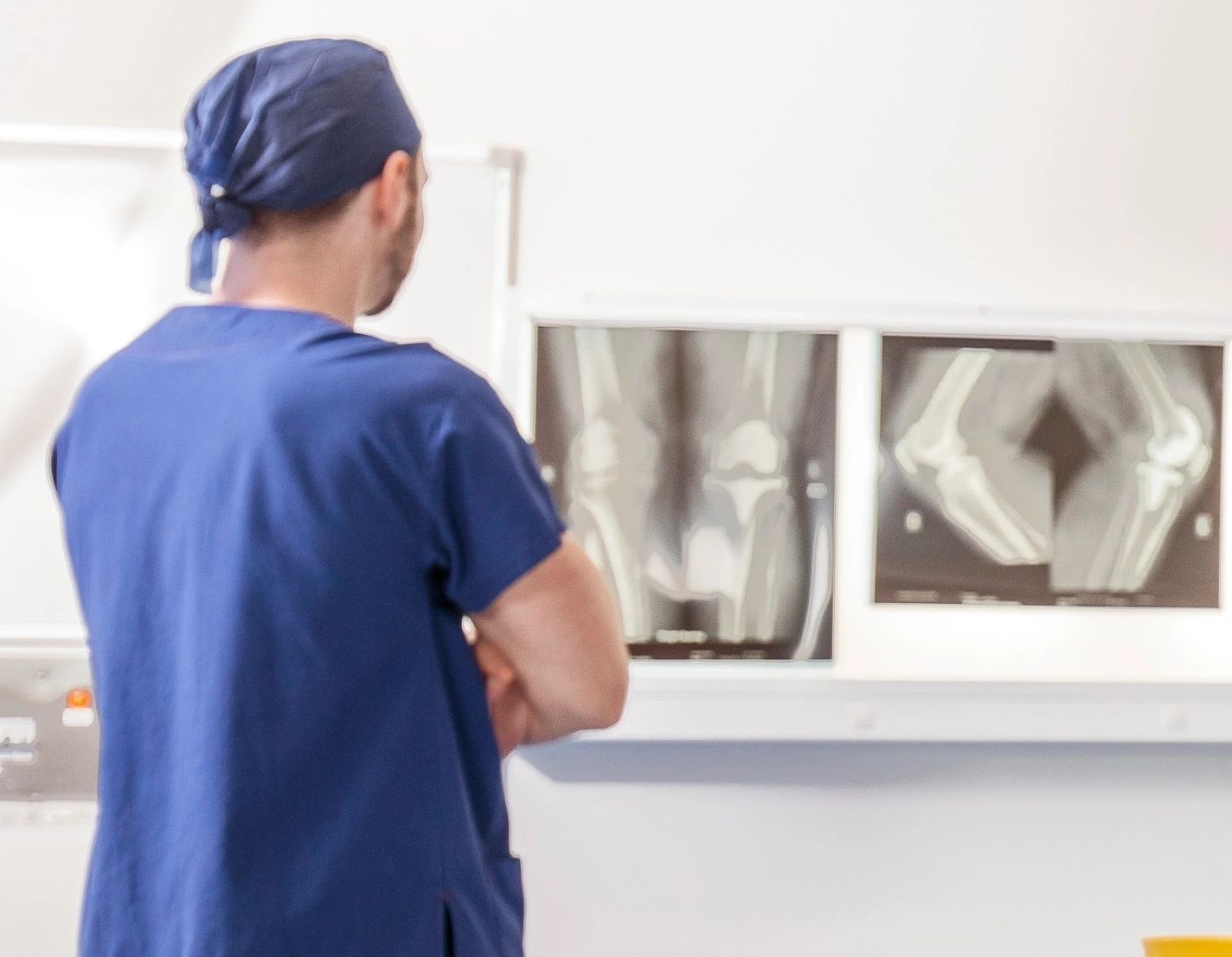
What is distal femur fracture surgery?
The distal femur is the lower end of the thigh bone (femur), just above the knee, and it forms the upper half of the knee joint. A distal femur fracture is a break in this part of the bone, and in some fractures the break extends into the knee joint. In a population study, these fractures occurred in about 9 in every 100,000 people each year. They became much more common after the age of 60, especially in women, and most followed a low-energy injury such as a fall from standing height; about 3 in 10 occurred around an existing knee replacement (a periprosthetic fracture) (PMID 29116356). In younger people, more often men, they usually follow high-energy injuries such as road accidents, while in older people, more often women, they usually occur in bone weakened by osteoporosis (PMID 39098785).
Surgery aims to restore the smooth joint surface and the alignment of the leg, and to hold the bone firmly enough to allow early knee movement and walking (PMID 39098785). The two most common methods are a plate fixed to the outer (lateral) side of the bone with locking screws, and a metal rod placed inside the bone from the knee end (a retrograde intramedullary nail) (PMID 39098785; PMID 36197809). For more difficult fractures, such as those with the bone broken into many pieces, weak osteoporotic bone or a fracture around a knee replacement, a nail and a plate, or two plates, may be combined to make the fixation stronger (PMID 39098785; PMID 40100415). For some fractures around an existing knee replacement, the lower end of the thigh bone and the knee replacement may instead be replaced with a larger knee replacement (a distal femoral replacement) (PMID 36738864).
A thorough clinical examination by a specialist and modern imaging help confirm the diagnosis and plan treatment. When the fracture extends into the knee joint, a CT scan is strongly recommended before surgery: in one study of these fractures, 38% also had a separate break running across the back of the rounded end of the bone (a coronal or “Hoffa” fracture), which can change the surgical plan and was found more often when a CT scan had been done (PMID 15741623).
What are the benefits of distal femur fracture surgery?
Surgery restores the joint surface and the alignment of the leg, and allows early joint movement and assisted walking. Minimally invasive approaches that spare the thigh muscles, and modern angle-stable (locking) implants, have helped make healing more predictable and allow an early return to function (PMID 39098785).
Both main methods of fixation give good overall results. In a 2026 review of 18 randomised trials (1,105 people), plates and nails gave similar function scores, healing and reoperation rates. Nailing was associated with shorter operations, bone healing about three weeks sooner and fewer infections, while plating was associated with less knee pain and slightly better knee bending (PMID 42202579). For difficult fractures, combining a nail and a plate was associated with fewer complications, fewer reoperations and fewer fractures that failed to heal than a single implant, and more people were allowed to put weight on the leg straight after surgery (PMID 40100415).
Getting back on your feet early is particularly important for older people. In reviews of mostly older patients, allowing early weight bearing after fixation did not increase complications or reoperations compared with restricting weight bearing (PMID 39465540; PMID 38777887). In older people, surgery within 48 hours of admission was associated with lower mortality at six months and one year than surgery delayed by more than four days (PMID 20830542), and surgical treatment was associated with better survival than non-surgical treatment (PMID 33992422).
What are the risks of distal femur fracture surgery?
A distal femur fracture is a serious injury, especially in older people. In people over 60, the risk of death in the year after a distal femur fracture was high and similar to that after a hip fracture, and it was higher in people with heart failure, dementia, advanced kidney disease or cancer, and in fractures around a knee replacement (PMID 20830542). In another study of people over 65 (median age 85), 14 of 59 died within the first year (PMID 33992422).
The bone does not always heal. Failure to heal (non-union) after fixation can occur in up to 19% of cases (PMID 39098785). In a study of 560 people treated with a lateral locking plate, about 1 in 10 needed another operation to help the bone heal; the risk was higher when the bone was broken into many pieces, when the leg healed out of alignment, and in people with obesity (PMID 41636737). In another study, open fractures (where the skin is broken), bone loss, anaemia and higher body weight increased the risk of non-union, and people whose fracture did not heal were more likely to have an infection and to need a total knee replacement later (PMID 36729004).
Each method has its own downsides. Nailing was associated with more knee pain and slightly less knee bending, and plating with more infections and slower healing (PMID 42202579). Combined nail-and-plate or double-plate fixation can be too stiff and may slow healing if not balanced (PMID 39098785). The evidence comparing treatments is limited, and a Cochrane review found it insufficient to say which treatment is best (PMID 36197809). For fractures around a knee replacement, distal femoral replacement had a higher rate of medical complications than fixation (23% compared with 9%), and about 1 in 8 people needed a further operation with either approach (PMID 36738864).
When the fracture extends into the knee joint, arthritis can develop later: in a small long-term study, half of the people had signs of arthritis on X-ray after an average of almost seven years (PMID 18714768). Other possible problems include knee stiffness, the bone healing out of alignment (malunion), infection, blood clots, wound problems and numbness around the incision. Plates, nails and screws can sometimes irritate and need to be removed once the bone has healed. There are also risks from the anaesthetic, which your anaesthetist will discuss with you.
Summary
Distal femur fracture surgery aims to restore the joint surface and alignment of the knee, and to hold the bone steady while it heals so that you can start moving the knee and walking early. Depending on the fracture, the quality of the bone and whether you have a knee replacement, this may involve a plate and screws, a nail inside the bone, a combination of both, or occasionally replacing the lower end of the bone. Surgery is usually recommended when the expected benefits for you outweigh the risks. You should discuss your injury, your scans and your goals, including your mobility, work and activities, with your fracture surgeon or knee surgeon so that you can consider the options and the indications for treatment together.
General information only. The information on this page is general in nature and does not replace individual medical advice. All surgery carries risks, and results vary between patients. Please discuss your own circumstances with your treating practitioner.