
Knee arthritis is the most common reason people see a knee surgeon, and most of them do not need an operation. This page explains what knee osteoarthritis is, how it is assessed, what non-surgical treatment can achieve, and when partial or total knee replacement is worth discussing. Dr Alexey Borshch is a Brisbane orthopaedic surgeon who consults in Hamilton and operates at Brisbane Private Hospital.
What is knee arthritis?
Osteoarthritis is the gradual wearing of the smooth cartilage that covers the ends of the bones, so that the joint becomes rougher, stiffer and more painful. It is by far the most common form of knee arthritis. It can affect the inner (medial) compartment, the outer (lateral) compartment, the kneecap joint (patellofemoral), or all three. Previous injury, meniscus or ligament surgery, limb alignment, body weight, family history and age all contribute. Inflammatory arthritis such as rheumatoid arthritis can also affect the knee and is managed together with a rheumatologist.
Symptoms
Typical symptoms are pain with walking, stairs and getting up from a chair, stiffness after sitting or first thing in the morning, swelling after activity, a grinding or crunching feeling, and gradually reducing walking distance. Some people notice the leg becoming bowed or knock-kneed as the cartilage wears on one side. Pain at night or at rest usually means the arthritis is more advanced. Symptoms often fluctuate, with flares and settled periods, and the severity of X-ray changes does not always match the severity of symptoms.
How knee arthritis is assessed
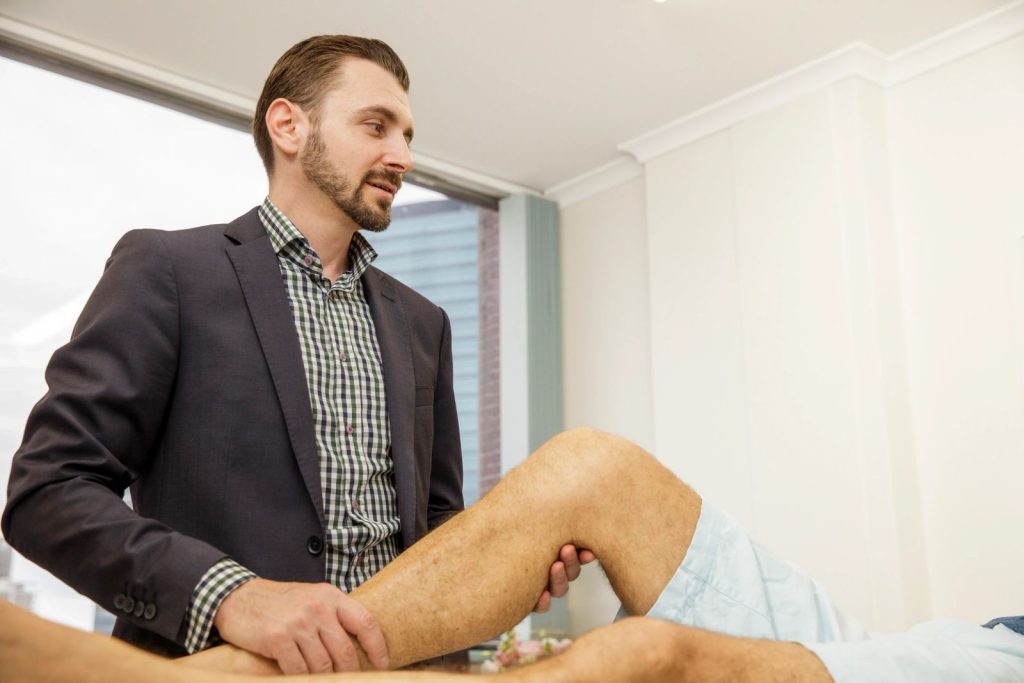
The assessment combines your history (what hurts, what makes it worse, what you have tried, what you want to get back to), an examination of the knee, your alignment and how you walk, and imaging. Standing (weight-bearing) X-rays are the most useful test for arthritis because they show how much joint space remains under load; an X-ray taken lying down can understate the problem. MRI is rarely needed to diagnose arthritis and often shows degenerative meniscus tears that are part of the arthritic process rather than a separate problem to operate on. A scan finding on its own is not a reason for surgery.
Dr Borshch also checks that the pain is actually coming from the knee: hip arthritis and back problems can refer pain to the knee, and conditions such as pes anserine bursitis or a stress fracture can mimic arthritis.
Non-surgical treatment
Non-surgical treatment is the first step for almost everyone and remains useful even when surgery is eventually needed. International guidelines recommend education, structured exercise and weight management as the core treatments for knee osteoarthritis (PMID 31278997).
Exercise and physiotherapy. A programme of strengthening, aerobic and flexibility exercise reduces pain and improves function in knee osteoarthritis, with high-quality evidence from more than 40 trials (PMID 25569281). The benefit is comparable to that of medication and has no side effects, but it needs to be kept up. A physiotherapist or exercise physiologist can build a programme around your knee and your fitness.
Weight management. For people who are overweight, losing weight reduces the load through the knee and the inflammation that drives pain. In the IDEA trial, diet combined with exercise produced about 10 per cent weight loss over 18 months, with less pain and better function than exercise alone (PMID 24065013). Your GP can advise on the options, including newer weight-loss medications where appropriate.
Medication. Paracetamol, anti-inflammatory tablets or gels, and other pain relief can help with flares and keep you active. They are best used in short courses and reviewed by your GP, particularly if you have heart, kidney or stomach problems. Opioids are not recommended for knee arthritis.
Injections. A corticosteroid injection into the knee can give worthwhile pain relief for a few weeks, which can be useful for a flare or to get through a holiday or an exercise programme (PMID 26490760). Repeated injections every three months over two years were associated with more cartilage loss and no better pain relief than placebo in a randomised trial, so steroid injections are used sparingly (PMID 28510679). Hyaluronic acid and platelet-rich plasma injections are available, but the evidence for them is mixed. Dr Borshch will explain what each is likely to achieve in your knee.
Braces, walking aids and activity changes. An unloader brace can help some people with arthritis confined to one side of the knee, a walking stick in the opposite hand reduces load, and swapping running or court sports for cycling, swimming or walking keeps you active with less pain.
Does keyhole surgery help knee arthritis?
Usually not. Arthroscopic "clean-out" surgery for an arthritic knee, including trimming a degenerative meniscus tear, has been compared with physiotherapy and with sham surgery in randomised trials and has not shown a lasting benefit over non-surgical treatment (PMID 23506518, PMID 24369076). Knee arthroscopy is reserved for specific mechanical problems, such as a locked knee from a displaced meniscus fragment or a loose body, rather than for arthritis itself.
Surgical options
Surgery is considered when pain and loss of function remain significant despite a proper trial of non-surgical treatment, the X-rays show advanced arthritis, and you are medically fit for an operation. Which operation depends on where the arthritis is, your alignment, your age and activity, and your goals.
Osteotomy. In younger, active patients with arthritis on one side of the knee and a bowed or knock-kneed leg, a high tibial osteotomy or distal femoral osteotomy realigns the leg to shift load onto the healthier side of the joint, preserving the natural knee and delaying replacement.
Partial knee replacement. When arthritis is confined to one compartment and the ligaments are intact, a partial (unicompartmental) knee replacement resurfaces only the worn part. Recovery is usually quicker and the knee tends to feel more natural, but the remaining compartments can wear later. Registry data show about 70 per cent of partial knee replacements are still in place at 25 years (PMID 30782341).
Total knee replacement. Total knee replacement resurfaces all the worn joint surfaces with metal and plastic components, and is the standard treatment for advanced arthritis affecting more than one compartment. In a randomised trial, total knee replacement followed by non-surgical treatment gave greater pain relief and functional improvement at 12 months than non-surgical treatment alone, though with more serious adverse events, which is why the decision is made carefully (PMID 26488691). About four in five patients are satisfied with the result; roughly one in five are not, most often because of persisting pain or unmet expectations, so a realistic discussion beforehand matters (PMID 19844772). Registry data show about 82 per cent of total knee replacements are still in place at 25 years (PMID 30782341). Dr Borshch uses robotic assistance for planning and alignment where appropriate, and rehabilitation after knee replacement is an important part of the result.
When should you consider knee replacement?
There is no X-ray threshold that decides this; it is a decision about how much the knee is limiting your life. Replacement is worth discussing when pain limits walking, work, sleep or the activities you value despite exercise, weight management and medication, when you have had a fair trial of non-surgical treatment, and when the X-rays show arthritis advanced enough to explain the symptoms. Having the operation earlier does not make the result better, and waiting while the knee is manageable rarely makes the operation harder, so there is usually time to decide. See how Dr Borshch decides whether knee surgery is appropriate.
Frequently asked questions
Will exercise wear my knee out faster?
No. Appropriate exercise reduces pain and improves function in knee arthritis and does not accelerate cartilage loss. Some discomfort during and after exercise is normal; pain that is much worse the next day means the programme needs adjusting, not stopping.
Do I need an MRI?
Usually not. Standing X-rays diagnose knee arthritis and guide treatment. An MRI is helpful when the X-rays are near-normal and a meniscus, ligament or cartilage injury is suspected, or when something unusual needs excluding.
How long does a knee replacement last?
Registry data suggest about 82 per cent of total knee replacements and about 70 per cent of partial knee replacements are still in place 25 years after surgery (PMID 30782341). Younger, heavier and more active patients place more demand on the implant, which is one reason the timing of surgery is discussed carefully.
Do I need a referral?
Yes. A current referral from your GP or another specialist is needed for a specialist consultation and for Medicare rebates. See your first appointment and fees, or request an appointment.
This page provides general information. Your diagnosis and treatment plan require an individual assessment.