
What is forearm fracture surgery?
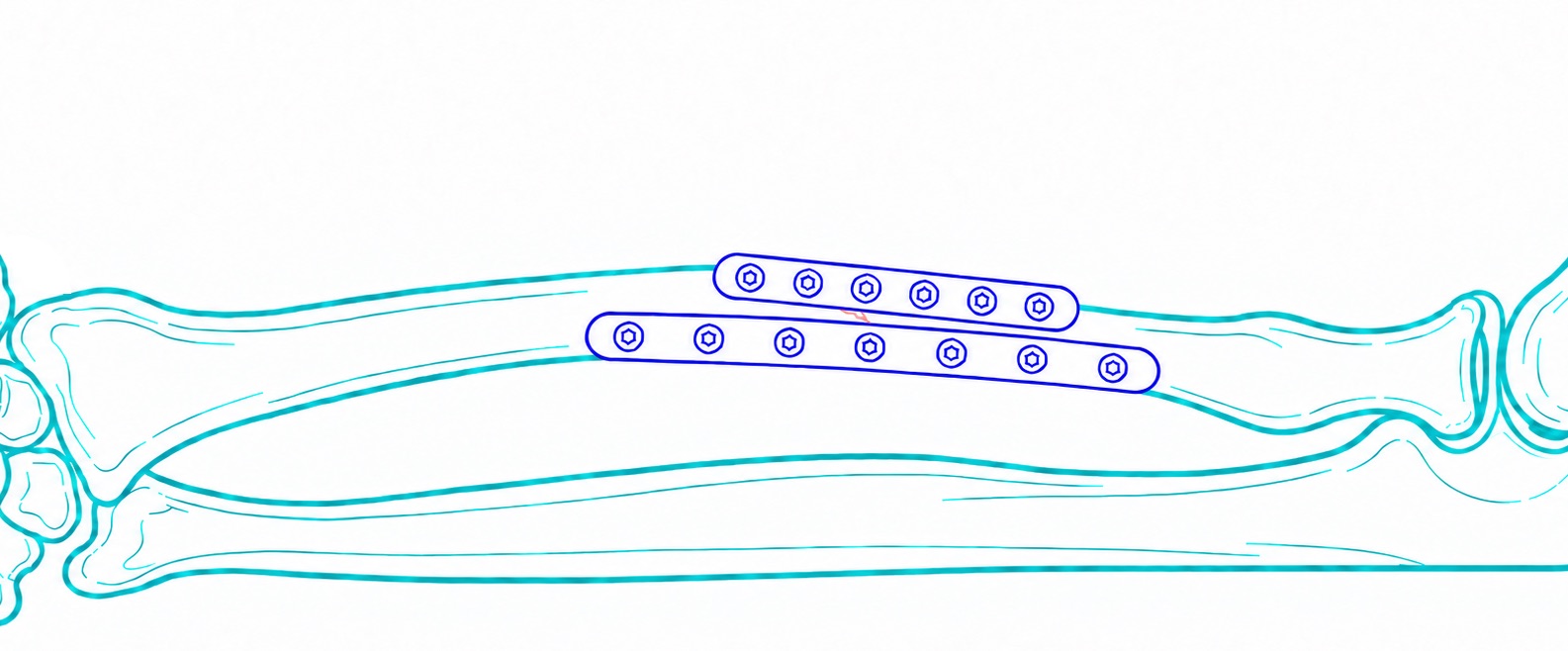
The forearm has two long bones: the radius, on the thumb side, and the ulna, on the little-finger side. They lie side by side and are joined at the elbow and the wrist. The radius bone is curved so that it can turn around the ulna to rotate the forearm and turn the palm up and down. Forearm fracture surgery treats breaks in the middle part (shaft) of one or both of these bones. In adults, these fractures make up 1–2% of all limb fractures (PMID 27499115), and forearm shaft fractures occur in about 13.8 in every 100,000 people, more often in children and less often with increasing age (PMID 40473979). Breaks at the lower end of the radius, near the wrist, are covered separately under distal radius fracture surgery.
In adults, plate fixation is regarded as the standard treatment for these fractures (PMID 25168787; PMID 39984810) because restoration of anatomical alignment, length and the natural curvature of the bones is essential to normal forearm function. This operation is called open reduction and internal fixation. Through an incision over each broken bone, the bone pieces are put back in position and held with a compression plate and screws, which press the bone ends together so that they heal (PMID 1091653; PMID 39984810). Some isolated fractures of the ulna, which often happen when the forearm is raised to shield against a blow, can be treated without an operation, in a brace or cast as long as its alignment is close enough to normal (PMID 22696319).
A thorough clinical examination by a specialist and modern imaging help confirm the diagnosis. X-rays of the whole forearm, including the elbow and the wrist, show where the bones are broken, how far they have moved and whether a joint at either end is also injured (called Monteggia and Galeazzi injuries).
What are the benefits of forearm fracture surgery?
Surgery restores the length, alignment and rotation of the forearm bones and holds them steady while they heal. In a study of 330 fractures of the radius and ulna treated with compression plates, 97.9% of radius fractures and 96.3% of ulna fractures healed (PMID 1091653). In another study of 129 fractures, 98% healed and 92% of patients had an excellent or satisfactory functional result (PMID 2918001).
Plate fixation restores nearly normal anatomy and forearm movement. In a study of 30 adults followed for an average of 5.4 years after plating of both forearm bones, turning the palm up (supination) reached 90% and turning the palm down (pronation) 91% of the range of the uninjured arm (PMID 18056493). In a further study of 23 patients after plating of both bones, people reported good overall arm function at an average of 34 months (PMID 15773649).
What are the risks of forearm fracture surgery?
Surgery does not always restore full strength. In the study of 30 adults, the strength of turning the forearm was 68–70% and grip strength 75% of the uninjured arm at an average of 5.4 years, and arm function scores were worse than normal (PMID 18056493). In the study of 23 patients, pronation, grip and pinch strength were significantly reduced, and people with less movement reported poorer function (PMID 15773649).
Sometimes the bone does not heal (nonunion) and further surgery may be needed. In a multicentre study of 131 adults treated with plates, 6.9% had a nonunion, and 3.8% developed a bridge of bone joining the radius and ulna (radioulnar synostosis), which limits rotation of the forearm. Nerve problems were present before surgery in 9% and persisted at final follow-up in 6.9% (PMID 27499115). In a study of 368 patients, nonunion occurred in 6.2% to 18.5% depending on the type of plate used (PMID 39984810). In an older series of 64 patients, a major complication occurred in 28% (PMID 6839596).
Infection is uncommon after closed fractures, but more likely when the bone has broken through the skin (an open fracture). In one series the infection rate was 2.3% (PMID 2918001), and in a study of 200 open fractures of the forearm, deep infection occurred in 5% overall and in 7% of the most severe open fractures (PMID 24674609).
Some people need a further operation to remove a plate, for example if it causes irritation, but the bone can break again after removal. In a study of 645 adults, refracture occurred in 6.3% of bones after plate removal, compared with 2.1% when the plate was left in place (PMID 35655741). In another study, the refracture rate was 12.9% after removal and 2.77% when the plate was kept (PMID 25168787). Other possible problems include stiffness, a visible scar and the risks of the anaesthetic, which your anaesthetist will discuss with you.
Summary
Forearm fracture surgery aims to restore the length, alignment and rotation of the radius and ulna and hold the bones steady while they heal, usually with plates and screws. Most fractures heal after surgery, but some strength may be lost and further surgery is sometimes needed. Surgery is usually recommended when the expected benefits for you outweigh the risks. You should discuss your injury, your X-rays and your goals, including your work, sport and other activities, with your fracture surgeon so that you can consider the options and the indications for treatment together.
General information only. The information on this page is general in nature and does not replace individual medical advice. All surgery carries risks, and results vary between patients. Please discuss your own circumstances with your treating practitioner.