Rehabilitation after total knee replacement rebuilds movement, strength and confidence through safe, progressive exercise tailored to your recovery. This guide explains the early weeks, exercises and warning signs.
People preparing for total knee replacement surgery often want a clear timetable: When will I walk normally? How far should my knee bend? Do I need inpatient rehabilitation? Recovery is more individual than a calendar. Age, general health, strength before surgery, the condition of the other leg, home support and the operation itself can all affect progress.
The aim is not to compete with somebody else’s recovery. It is to regain safe mobility and useful knee function while allowing tissues to heal. Your surgeon and physiotherapist should adapt rehabilitation to your circumstances.
Before surgery: does “prehab” help?
Being as active and strong as your knee comfortably allows may make the first days after surgery easier. Prehabilitation commonly includes education, quadriceps and hip strengthening, aerobic exercise and practising with walking aids. A 2022 systematic review of 16 trials involving 968 people found low- to very-low-certainty evidence that prehabilitation improved knee function before surgery and for up to three months afterwards, but not at six to twelve months. Read the PubMed study.
That means prehab may provide a useful early advantage, but it cannot guarantee a faster or better final result. Exercise should be adjusted if it causes a marked or lasting increase in pain or swelling.
The hospital phase: movement begins early
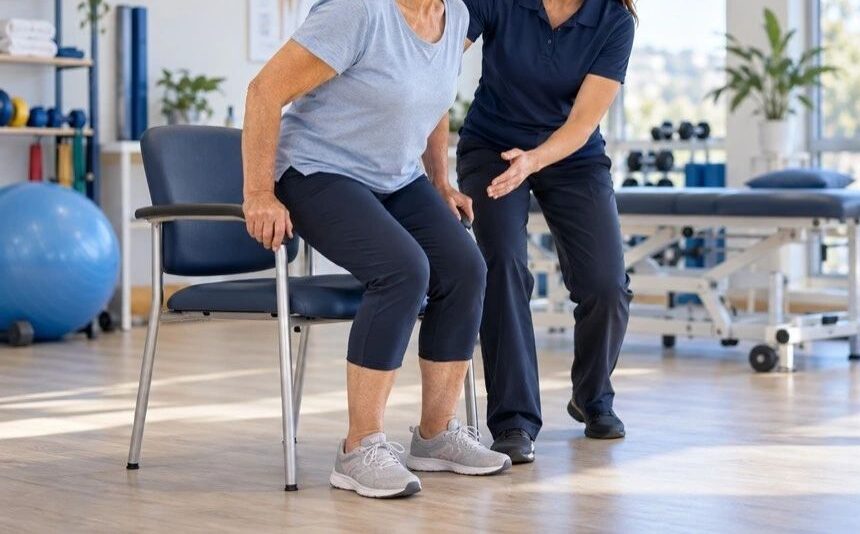
For many patients, rehabilitation following total knee replacement starts on the day of surgery or the following morning. The early priorities are getting in and out of bed safely, standing, walking with an appropriate aid, managing stairs if required, and performing simple circulation and muscle-activation exercises.
It is normal for the knee to be painful, warm and swollen. Bruising can extend into the thigh, calf or ankle. Pain relief, ice when recommended, elevation and short, frequent periods of movement can help. Medication should be taken only as directed by the treating team.
A physiotherapy clinical practice guideline supports early mobility, progressive strengthening, range-of-motion exercise, balance training and a tailored home program after knee replacement. It also recommends monitoring function so treatment can be changed when recovery is slower or faster than expected. Read the guideline on PubMed.
The first six weeks: consistency matters
Most programs include knee-straightening and bending exercises, quadriceps activation, walking practice, and strengthening for the knee and hip. Several short sessions are often more manageable than one exhausting session. More pain is not necessarily evidence of more progress: an excessive workload can increase swelling, temporarily inhibit the thigh muscles and make bending harder.
There is no single flexion number that every patient must reach on the same day. Functional goals and trends matter more than comparing one measurement with a stranger’s result online. Contact your treating team if the knee is becoming stiffer rather than gradually improving, or if pain prevents you from completing the agreed program.
Walking aids are used for safety and to improve gait quality. The right time to move from a frame to crutches, then a stick or no aid, depends on balance, strength, comfort and whether you can walk without a pronounced limp. Stopping an aid too early is not a milestone if it makes walking unsafe.
Home exercise or supervised physiotherapy?
Both can be appropriate. An Australian-led systematic review and meta-analysis found no clinically important advantage for inpatient or clinic-based rehabilitation over a structured home program after uncomplicated total knee replacement. The review included 752 people in comparisons of clinic- and home-based care and found similar pain and function outcomes at ten and 52 weeks. Read the JAMA Network Open review on PubMed.
This does not mean that everybody should rehabilitate alone. Supervised physiotherapy may be particularly useful when progress is limited, confidence is low, the home environment is difficult, there are other health or balance problems, or exercise technique needs correction. The safest program is the one matched to the patient, with access to review if recovery departs from the expected course.
Is a continuous-passive-motion machine necessary?
Continuous-passive-motion, or CPM, machines gently bend and straighten the knee while a person rests. They were once used routinely. A Cochrane review found that CPM did not produce clinically important improvements in active knee bending, pain, function or quality of life and therefore did not support routine use after knee replacement. Read the review on PubMed.
There may be selected situations in which a treating team recommends a device, but it does not replace active movement, strengthening and walking practice.
What happens after six weeks?
As swelling and pain settle, rehabilitation usually shifts towards strength, endurance, balance and everyday goals. These may include longer walks, stairs, gardening, work tasks, cycling or swimming once wounds are healed and the clinical team agrees. Improvement can continue for many months; occasional swelling after increased activity does not necessarily mean that something is wrong.
Driving and returning to work should be discussed individually. The operated side, vehicle, medication use, job demands, reaction time and ability to perform an emergency stop all matter. High-impact activity may not be suitable after a total knee replacement, whereas lower-impact exercise is commonly encouraged.
When should you seek help?
Contact your surgical team promptly for increasing wound redness or drainage, fever, rapidly worsening pain, or a sudden loss of movement. Urgent medical assessment is needed for chest pain, shortness of breath, or new calf pain and swelling because these can be signs of serious complications. If you are uncertain, it is safer to ask.
Choosing an orthopaedic surgeon and rehabilitation plan involves more than searching for the “best knee replacement surgeon.” A useful consultation should explain realistic benefits, risks, alternatives and the likely recovery for your situation. Patients considering surgery in Brisbane can learn more about Dr Alexey Borshch’s qualifications and approach or request an appointment.
This article provides general education and is not a substitute for individual medical advice. Your rehabilitation instructions may differ for valid clinical reasons; follow the plan provided by your own surgeon and physiotherapist.