
Hip arthritis is the most common reason people see a hip surgeon, and many are managed for years without an operation. This page explains what hip osteoarthritis is, how it is assessed, what non-surgical treatment can achieve, and when total hip replacement is worth discussing. Dr Alexey Borshch is a Brisbane orthopaedic surgeon who consults in Hamilton and operates at Brisbane Private Hospital.
What is hip arthritis?
The hip is a ball-and-socket joint. Osteoarthritis is the gradual wearing of the smooth cartilage covering the ball (femoral head) and the socket (acetabulum), so that the joint becomes stiff, rough and painful. Contributing factors include the shape of the hip (such as a shallow socket or femoroacetabular impingement), previous injury or childhood hip conditions, family history, body weight and age. Less commonly the hip is affected by inflammatory arthritis, avascular necrosis (loss of blood supply to the femoral head) or arthritis following a fracture.
Symptoms
Hip arthritis typically causes pain in the groin, sometimes spreading to the front of the thigh or the knee, with stiffness that makes it hard to put on shoes and socks, cut toenails or get in and out of a car. Walking distance gradually shrinks, a limp develops, and pain may disturb sleep. Pain on the outside of the hip is more often bursitis or tendon pain than arthritis, and pain in the buttock is more often from the back. Working out where the pain is coming from is the first step; you can read about the common locations of hip pain and what they might mean.
How hip arthritis is assessed
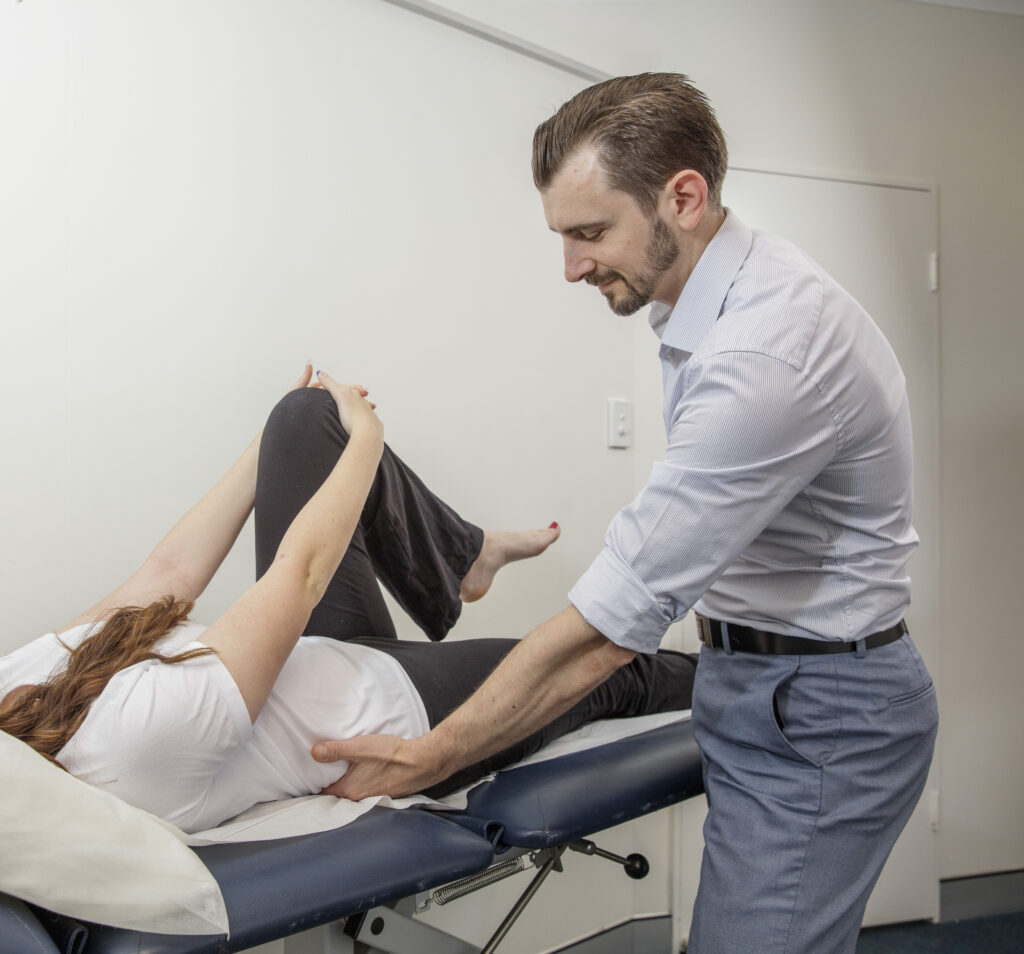
The assessment combines your history (where the pain is, what makes it worse, what you have tried, what you want to get back to), an examination of hip movement, strength and gait, and a check of the back and knee, with imaging. A standing X-ray of the pelvis and hip is usually all that is needed to diagnose arthritis and to see how much joint space remains. MRI is reserved for hips with normal or near-normal X-rays where a labral tear, impingement, avascular necrosis or a stress fracture is suspected. As with the knee, the severity of X-ray changes does not always match the symptoms, and a scan finding on its own does not determine whether surgery is appropriate.
Non-surgical treatment
International guidelines recommend education, exercise and weight management as the core treatments for hip osteoarthritis, with medication and injections used to support them (PMID 31278997).
Exercise and physiotherapy. Land-based exercise reduces pain and improves function in hip osteoarthritis, with high-quality evidence from randomised trials (PMID 24756895). Strengthening the muscles around the hip, keeping the joint moving and maintaining general fitness with low-impact activity such as cycling, swimming or walking all help. A physiotherapist can tailor a programme to your hip.
Weight management. Reducing body weight lowers the load through the hip with every step and improves symptoms in people who are overweight. Your GP can advise on the options.
Medication. Paracetamol and anti-inflammatory medication can help with flares and keep you active, used in short courses and reviewed by your GP, particularly if you have heart, kidney or stomach problems. Opioids are not recommended for hip arthritis.
Injections. Because the hip joint is deep, injections are given under ultrasound or X-ray guidance. In a randomised trial, a single guided corticosteroid and local anaesthetic injection added to advice and education gave greater improvement in hip pain over six months than advice and education alone, particularly when there was inflammation in the joint on ultrasound (PMID 35387783). The relief is temporary and injections are not repeated frequently; a steroid injection is also avoided in the three months before a hip replacement because it is associated with a higher risk of infection around the new joint (PMID 36592824). Hyaluronic acid and platelet-rich plasma injections have weaker evidence in the hip than in the knee.
Walking aids and activity changes. A walking stick in the opposite hand noticeably reduces the load through an arthritic hip, and adjusting the activities that aggravate it keeps you moving with less pain.
Surgical options
Total hip replacement is the main operation for hip arthritis. The worn ball and socket are replaced with implants, relieving the arthritic pain and restoring movement. It is one of the most reliable operations in orthopaedics: a large meta-analysis of case series and national registries found that around 58 per cent of hip replacements were still in place at 25 years, with higher survival in the first 15 years (PMID 30782340). Read about total hip replacement and rehabilitation after hip replacement.
Surgical approach. The hip can be reached from the front (direct anterior approach), the side or the back. Dr Borshch uses the anterior approach for suitable patients because it works between muscles rather than detaching them; the choice depends on your anatomy, the condition of the hip and other individual factors, and all approaches can give a good result.
Hip arthroscopy and joint-preserving surgery have a role in younger patients with impingement or labral tears before arthritis is established, but once cartilage loss is advanced they are unlikely to help, and hip replacement becomes the appropriate option.
Problems after hip replacement such as loosening, wear, instability, infection or a fracture around the implant are assessed and treated with revision hip replacement where needed.
When should you consider hip replacement?
Hip replacement is worth discussing when pain limits walking, work, sleep or the activities you value despite exercise, weight management and medication, when stiffness is affecting everyday tasks, and when the X-rays show arthritis advanced enough to explain the symptoms. There is usually time to decide; waiting while the hip is manageable rarely makes the operation harder, although a hip that has become very stiff or has lost a lot of bone can be more demanding to replace, so progressive stiffness or shortening of the leg is worth reviewing. See how Dr Borshch decides whether hip surgery is appropriate.
Frequently asked questions
Is my groin pain definitely the hip?
Groin pain with stiffness and a reduced range of hip movement is usually the hip joint, but hernias, tendon problems and the lower back can cause similar pain. The examination and a standing X-ray usually settle the question; occasionally a guided local anaesthetic injection into the joint is used to confirm the source of pain.
Will exercise damage an arthritic hip?
No. Exercise reduces pain and improves function in hip arthritis. Low-impact activities are usually best tolerated, and some discomfort during and after exercise is expected; a programme that leaves you much worse the next day needs adjusting rather than stopping.
How long does a hip replacement last?
Registry data suggest that around 58 per cent of hip replacements are still in place 25 years after surgery, and most last well beyond 15 years (PMID 30782340). Modern bearing materials are expected to improve on this, but the timing of surgery in younger patients is still discussed carefully.
Do I need a referral?
Yes. A current referral from your GP or another specialist is needed for a specialist consultation and for Medicare rebates. See your first appointment and fees, or request an appointment.
This page provides general information. Your diagnosis and treatment plan require an individual assessment.